Showing posts with label Species descryption. Show all posts

Wednesday, 5 November 2014

Carpet python morphs

Today I will write something about carpet python morphs and subspecies. As you know Carpet python group consist of several subspecies and morphs. I think that in future this species will be way more popular than now. Carpet pythons for sure in future will have more morphs than popular ball python. This snakes are semi - arboreal and active during the day that make from them very good exposition snake. From that what I hear their poo don't smell so bad like some other snakes. :P


Diamond Python (Morelia spilota spilota)
-------------------------------------------------------------------------------------------------

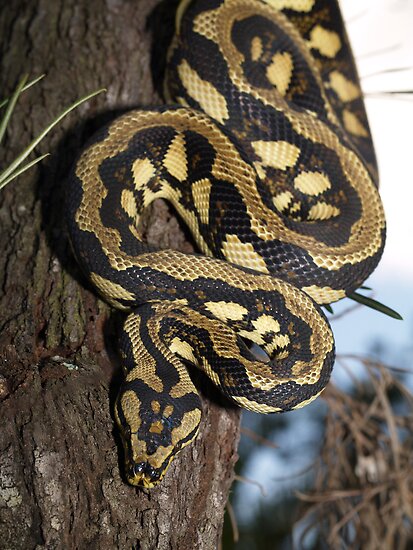
I will start from main subspecies Morelia spilota spilota popularly known as diamond python. This is a main subspecies from Australia and python who's live on the most southern territories and on the highest altitude from all pythons. These python lives on very various habitats from urban, woodlands to rocky habitat. Diamond pythons mainly feed on mammals but from time to time they also eat birds and lizards. Some populations around Lake Victoria in Australia are threatened with extinction. Diamond's can survive in lower temperatures than other carpets and stay dormant up to six months during one year. During breeding season males are don't fight with each other. Diamond pythons instead of fighting are making breeding balls similar to those like in anaconda, where many males try to copulate with one female. It is possible for female to grow up to 9 ft (but usually much smaller).

Wild Diamond
http://ectotherms.net/kyherpsoc/Propagating%20Carpet%20Pythons%20Webpage_files/image017.jpg

Black and white form is rarer than yellow in trade.
http://www.ryanphotographic.com/diamond%20python.jpg

Diamond python yellow form
http://www.pythonidae.nl/Pythonidae

Dark Diamonds
http://www.cuttingedgemorelia.com/site/images/stories/CuttingEdgeMorelia/Section_Projects/Diamonds_Dark/Gallery/black_diamond.jpg

Striped Diamond
http://www.snakeranch.com.au/images/sendbinary.asp?width=645&path=imagesDB/wysiwyg/Diamond(Tareelocale).JPG


Jungle carpet python (Morelia spilota cheynei)
-------------------------------------------------------------------------------------------------

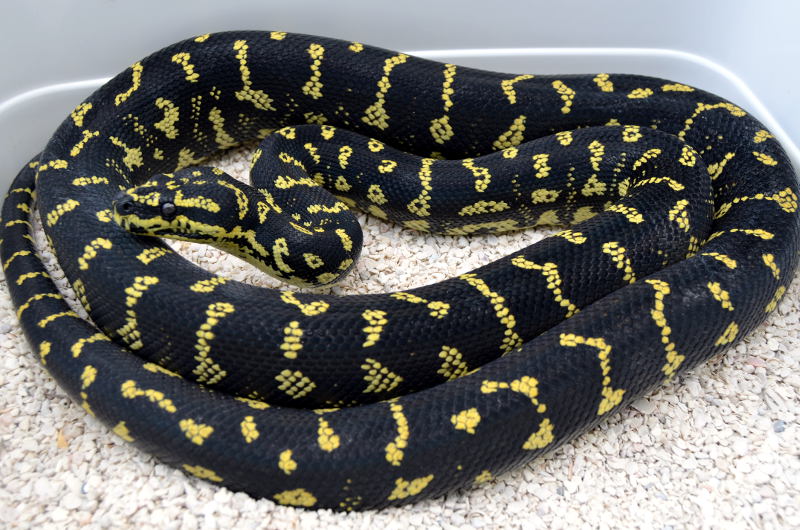
This subspecies lives in the most tropical habitat and is the smallest from all carpets they are don't longer than 6 - 7 ft. Jungle carpets lives in Queensland and Cape York Peninsula. These is the most arboreal species from all carpets and they inhabit a rain forest canopy.

Wild form
http://www.oakvalefarm.com.au/images/jungle_carpet_python.jpg

Ivory black and white form
http://www.theradzoo.com/wp-content/uploads/2012/09/Jungle-Carpet-Python.jpg

Tully locality jungle
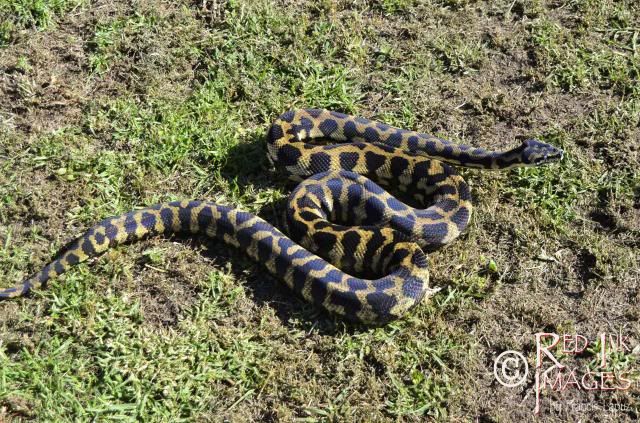
http://i305.photobucket.com/albums/nn214/Red-Ink-Buldogs/Greyham/G15_zps77543b34.jpg

Babinda locality jungle
http://trexreptiles.net/wp-content/uploads/2012/08/babinda-4.jpg

Palmerston locality jungle
http://ih2.redbubble.net/image.4059535.5274/flat,550x550,075,f.jpg

Atherton localities jungle
http://www.ebmorelia.com/publishImages/Collection~~element219.jpg

Zebra jungle
Zebra is the co - dominant trait. The zebra gene is gene from jungle pythons.
http://www.ukpythons.com/imgs/gallery/zeb3.jpg

Super Zebra
http://www.ukpythons.com/imgs/gallery/szeb1.jpg

Striped/Tiger form
http://www.moreliapythonradio.com/publishImages/Morphs-of-the-Morelia-complex~~element87.jpg

Highlighter jungle
http://www.australianaddiction.com/JCP_Highlighter2013.jpg


Coastal carpet python (Morelia spilota mcdowelli)
-------------------------------------------------------------------------------------------------

Coastal carpet python is the biggest subspecies usually growth to 7 ft but 14 ft specimens are recorded. Coastals lives in wide range of habitats but mainly in forests. Range from Cape York peninsula to South Wales. This taxa is the most variable in patterns and colors which is presented in variety of morphs.

Wild form
http://www.ukpythons.com/imgs/gallery/BrF.jpg

Port Douglas localities coastal
http://www.ebmorelia.com/Port_Douglas-F.jpg

High contrast coastal
http://static.squarespace.com

High contrast tiger coastal
http://ectotherms.net/kyherpsoc/Propagating%20Carpet%20Pythons%20Webpage_files/image077.jpg

Red coastal
http://www.moreliapythonradio.com/publishImages/Morphs-of-the-Morelia-complex~~element239.jpg

Red tiger
http://www.moreliapythonradio.com/publishImages/Morphs-of-the-Morelia-complex~~element238.jpg

MPenn Line coastal
https://static.squarespace.com/static/502928b784ae02c19c94a1d1/502ad72a84ae8782450178d7/502ad730e4b0d642355d996c/1344984880495/Sonja%203.jpg?format=750w

Ocelot caramel
http://www.moreliapythonradio.com/publishImages/Morphs-of-the-Morelia-complex~~element247.jpg


MORE MORPHS Click Read More!

Thursday, 9 January 2014

Carpet python (Morelia spilota) - short descryption.

Common names: Carpet python or Moran (on Papua New Guinea).

 Morelia spilota cheynei from http://snakeworld.hpage.co.in/

Descryption: Carpet python is snake from pythonidae familly, like all pythons they lay eggs and in this species clutch size is really big - up to 28 eggs. They presents varaiety of patterns and colors as subspecies from bright yellow jungle carpet trough brownish Coastal carpet python to interesting pattern of Diamond python. Carpet python feed mostly on marsurpials and other mammals sometimes eat lizards and birds (they have good developed thermal pits used to detect endothermic animals). As a arboreal monsters* they have also prehensile tails and often seen on trees as juvenile and in forests habitats.

Taxonomy:
Kingdom:Animalia
Phylum:Chordata
Subphylum:Vertebrata
Class:Reptilia
Order:Squamata
Suborder:Serpentes
Family:Pythonidae
Genus:Morelia
Species:M. spilota
wikipedia.com

Subspecies: Diamond (Morelia spilota spilota), Northwestern carpet python (M. s. variegata), Southwestern carpet python (M. s. imbricata), Coastal carpet python (M. s. mcdowelli), Jungle carpet python (M. s. cheynei), Inland carpet python (M. s. metcalfei), Papuan carpet python or Irian jaya (M. s. ssp.). With Papuan carpet python or Irian jaya is taxonomical problem becouse Hoser in 2000 named it as M. s. harrisoni witch is invalid name and this taxon need more further research currently described as M. s. ssp. species inquirenda ("“Species inquirenda”(pl. species inquirendae): This is “a Latin term meaning a species of doubtful identity requiring further investigation” (ICZN 1999: glossary entry)").

Morelia bredli is also in artificial taxonomy group named as carpet pytons but its isnt subspecies of Morelia spilota. M. bredli is other species and is probably sister clade to M. spilota.

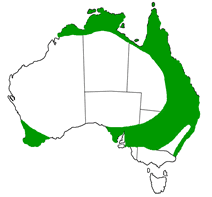
Geographic range: Widely distributet troughout mainland Australia, New Guinea Island and Youle Island.

from http://www.wareptilepark.com.au/

Habitat: Carpet pythons occurs in very wariety habitats: moonson forests, dry forests, woodlands, grasslands and even open savanna habitats. Morelia spilota is semi arboreal species but as juvenile they climb on trees very often.

Lenght: 1,5 to even 4 m (Coastal carpet python).

Lifespan: in captivity more than 20 years

Behaviour: They are powerfull predrators and as a baby the can be agresive (like most of juvniles snakes) but with growing they calm down and dont even need to be handling and tammed (its probably depends from their size if they are bigger they feel more safetly). They are slow in movement and don't need big vivariums. Mostly active on evening and nightime hours and they constantly move what makes them great exhibition animal.


Wednesday, 18 December 2013

Amazon Tree Boa (Corallus hortulanus) Short Descryption

Other common names:  Garden tree boa,Common tree boa, Cooki tree boa.


Description: Corallus hortulanus is a slim species from Boidae family. Like almost all Boids don't lay eggs becouse they are ovoviviparous. This species have various varaiety of colours and patterns from orange, red to brown and sometimes have stripes, speckles, saddled witch rombhoid or chevron shapes or even paternless. They are living in huge area of 5 000 000 km in Amazon basin. It's possible that this ATB can contain cryptic species but we don't have sufficient data to prove or deny this possibility.
Taxonomy: 
   
Kingdom:Animalia
Phylum:Chordata
Subphylum:Vertebrata
Class:Reptilia
Order:Squamata
Suborder:Serpentes
Family:Boidae
Subfamily:Boinae
Genus:Corallus
Species:C. hortulanus
    wikipedia.com

Subspecies: Currently we can recognize two subspecies C. hortulanus hortulanus who occurs in the Guianas, Amazonia, and south-eastern Brazil, and C. hortulanus cooki from southern Central America, northern Columbia, northern Venezuela, Trinidad and Tobago, and the southern Windward Islands.

Geographic range: Neotropical, typically found below 300m elevation.


Habitat: Generally ATB occurs in tropical rainforest often seen on trees along the river. This taxon occurs also in dryer forest and South American grassland.

Lenght: 1,5 - 2m, males are little shorter.

Adult weight: 600g - 1,5kg.

Lifespan: in captivity 12 - 20 Years.

Behaviour: They are aggresive species especially as juveniles which is defensive strategy for all boids and pythons. They gives some warrnings what includes gentle bites (still hurtfull becouse of their long thooth). In night time and after feeding they are in hunting moode and the best things to do is not handle them, they can try attack everything what they see. Hovewer they can used to humans handling and stop bitting but no all of them and this still requires some time and work. They also anchor themselves while handling and they are able to constrict on human body parts ( but they cant kill humans).