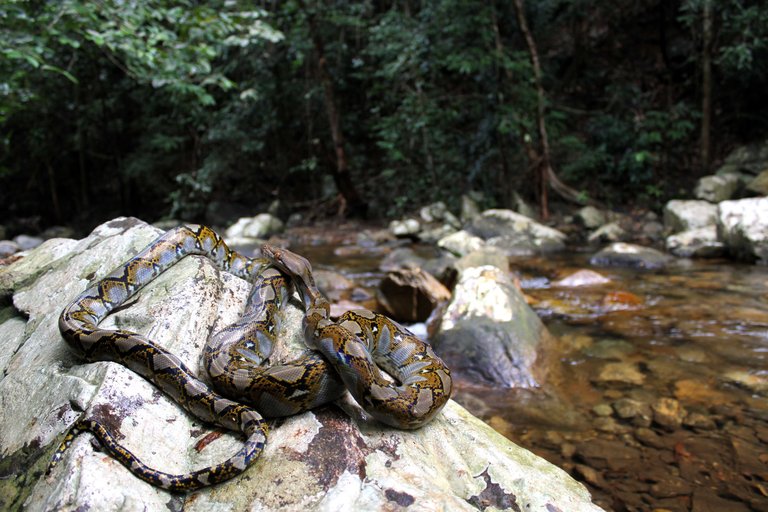
Showing posts with label Pythons. Show all posts

Sunday, 19 July 2015

Arboreal adaptations of snakes.


To start with, I will show you pictures of snakes that occupy different ecosystems and you will probably instantly notice some differences between them. Those differences cover not only the appearance of the snakes but also their behaviour and foraging strategies.

Morelia viridis - Arboreal green tree python
http://www.reptilesmagazine.com/Care-Sheets/Snakes/Green-Tree-Python/


Cerastes Cerastes - Ground/burrowing  horned desert viper
http://rivista-cdn.reptilesmagazine.com/Hornviper_Cerastes_cerastes.jpg?ver=1385057346


Laticauda colubrina -  Sea living banded sea krait
http://www.arkive.org/banded-sea-krait/laticauda-colubrina/image-G125624.html

As you can see they are pretty different. What causes this variation? The answer is simple: Evolution! Those differences are adaptations to particular ecosystems. Snakes that occupy same or similar habitat will share some of the adaptations, for example, cryptic skin pattern of snakes' that hide between fallen leaves on the forest's ground.

But what about arboreal snakes? Does arboreal snakes share some similarities? 

Amazon tree boa (Corallus hortulanus)
http://www.sciencephoto.com/media/379847/view

Asian vine snake (Ahaetulla prasina)
http://www.arkive.org/

Green pit viper (Trimeresurus albolabris)
http://commons.wikimedia.org/

These snakes represent three different taxa, so they aren't closely related to each other. Amazon tree boa represent Boidae and lives in South America, Asian vine snake is Colubrid snake from
South-East Asia as well as Green pit viper which, as name shows, represent Vipers. All of those snakes spent majority of their lives on trees and their branches.  There are a lot of shared adaptations which are common in arboreal snakes and rarely seen in snakes occupying different ecological niches. The arboreal specialization is  characteristic for tropical climate.


But what exactly 'Arboreal' means?
'Arboreal' (latin arbor - tree) means: Living in or among trees.
Putting this in more comprehensive answer, arboreality is a trait showing consistent association with trees. This trait is adaptive to some aspects of environmental and ecological conditions.

Arboreal snakes have several body modifications that help them survive and be successful predator in the tree canopy.


  • They have characteristic mid body lateral flatness, more broadly said, they are more slender and flatter than other non-arboreal snakes.
  • Longer tail length in relation to body length and tail prehensility (which means an organ adapted to holding or grasping)
  • Smaller sizes of clutches. The slender body might predestine those snakes to have smaller clutch size. This gives possibility for mothers not to have a handicap since they live on the trees. 
  • Shift in the position of ovaries. This ovarian asymmetry gives them ability to minimize body distention during pregnancy period. Lack of strong distention keeps them slender even while keeping big follicles.
  • Ontogenetic color changes and polimorphism. It enables snakes' to live in different ecological niches (for example in different height of the trees).
  • High aggression (decreases with age). It is defending mechanism for youths and an excellent feeding response that helps them survive in natural environment and to thrive in captivity.
  • Bigger heads in relativity to body length and generally, strong, heart-shaped heads. This distinctive shape is a result of presence of strong jaw muscles to prevent their prey from escape. 
  • Longer teeth. Arboreal snakes have one of the longest teeth in snake's world. For example Emerald tree python and Green tree python can reach teeth size of 3-4 cm that is close to length of Gabon viper fangs (longest snake-world fangs)!

This is a head of Emerald tree boa that I have dissected a year ago. You can see there a pretty devastating teeth (and yes! during preparation my gloves were pierced all the time).
  • My research suggests that constricting snakes like pythons and boas have lengthen nasal complex in relativity to other snakes, that probably allows them more precise grasp of the agile prey. You can see this long nasal complex on the picture above. 
  • Good vision. We can even assume that the best from all snakes: from excellent binocular vision of vine snakes to special light reflecting layer of tapetum lucidum in tree boas (that's why one of the easiest ways of searching for those snakes is with flashlight). Good vision helps them localize prey and be more accurate during striking.

https://blogger.googleusercontent.com/img/b/R29vZ2xl/AVvXsEhNcAcV-lGQltiURD6sRGW8rrTgwAKwBmMvHbXgF-A57jeKwF5PsMvxPrIjRvFqpH56duy1Z5CWhFoLS-GanZs4QMzukCs-XI9_2lPSK4V0SEaH3YtYnvCkwHeA5a_PidmLrdb_SalURkca/s1600/Tree+boa.JPG

  •  Arboreal snakes have almost no possibility for precise thermoregulation. There is a small amount of sunlight that pierce trough dense tree canopy and all sunny locations are unpopular, probably because of the risk of predation. As a result of living in this environment they have lower body temperature than other snakes. Additionally, the arboreal nocturnal snakes have lower body temperature than diurnal arboreal snakes (which is quite obvious).


The ultimate adaptation to living on tress is diving, or air sliding, or more popularly called - flying.
The South-East Asian Chrysoplea taxa, known as paradise snakes, posseses the ability to move from one tree to another trough gliding in the air. This is really amazing and in few words it is achieved by basically further flattening the body. 
Here is a short video from National Geographic where you can see this amazing ability.


Arboreal snakes are highly adapted to their environment and they are undoubtedly successful predators. Those interesting snakes in a variety of ways are 'marvelous monsters' of the natural world and as a pet snake they can give an opportunity to observe interesting behaviours and admire unique colors and patterns. The only disadvantages with those snakes are high price and demand of specific conditions to keep (and breed) them with success.

I think this post is already longer that I've expected, so if you'll still have any questions, do not hesitate to ask in comments section  and I will try my best to answer them.
Cheerio!

Wednesday, 5 November 2014

Carpet python morphs

Today I will write something about carpet python morphs and subspecies. As you know Carpet python group consist of several subspecies and morphs. I think that in future this species will be way more popular than now. Carpet pythons for sure in future will have more morphs than popular ball python. This snakes are semi - arboreal and active during the day that make from them very good exposition snake. From that what I hear their poo don't smell so bad like some other snakes. :P


Diamond Python (Morelia spilota spilota)
-------------------------------------------------------------------------------------------------

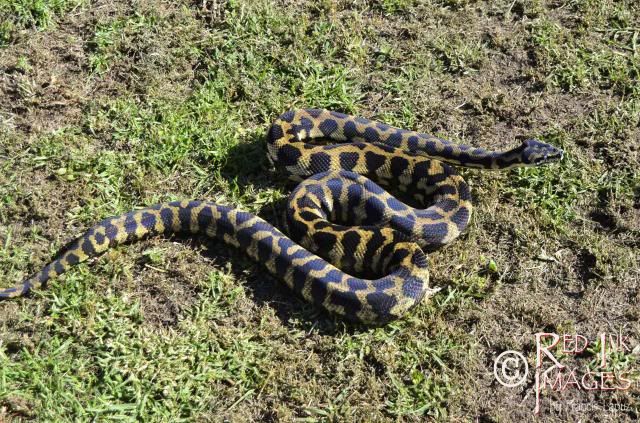
I will start from main subspecies Morelia spilota spilota popularly known as diamond python. This is a main subspecies from Australia and python who's live on the most southern territories and on the highest altitude from all pythons. These python lives on very various habitats from urban, woodlands to rocky habitat. Diamond pythons mainly feed on mammals but from time to time they also eat birds and lizards. Some populations around Lake Victoria in Australia are threatened with extinction. Diamond's can survive in lower temperatures than other carpets and stay dormant up to six months during one year. During breeding season males are don't fight with each other. Diamond pythons instead of fighting are making breeding balls similar to those like in anaconda, where many males try to copulate with one female. It is possible for female to grow up to 9 ft (but usually much smaller).

Wild Diamond
http://ectotherms.net/kyherpsoc/Propagating%20Carpet%20Pythons%20Webpage_files/image017.jpg

Black and white form is rarer than yellow in trade.
http://www.ryanphotographic.com/diamond%20python.jpg

Diamond python yellow form
http://www.pythonidae.nl/Pythonidae

Dark Diamonds
http://www.cuttingedgemorelia.com/site/images/stories/CuttingEdgeMorelia/Section_Projects/Diamonds_Dark/Gallery/black_diamond.jpg

Striped Diamond
http://www.snakeranch.com.au/images/sendbinary.asp?width=645&path=imagesDB/wysiwyg/Diamond(Tareelocale).JPG


Jungle carpet python (Morelia spilota cheynei)
-------------------------------------------------------------------------------------------------

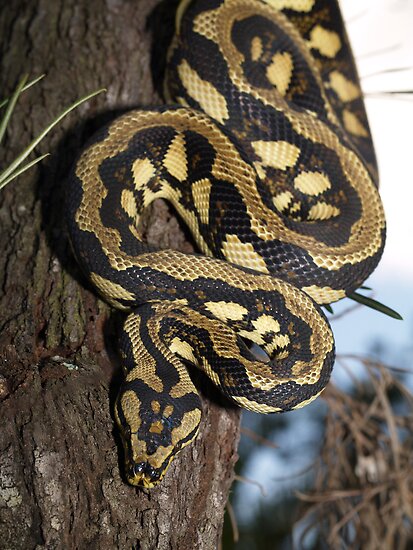
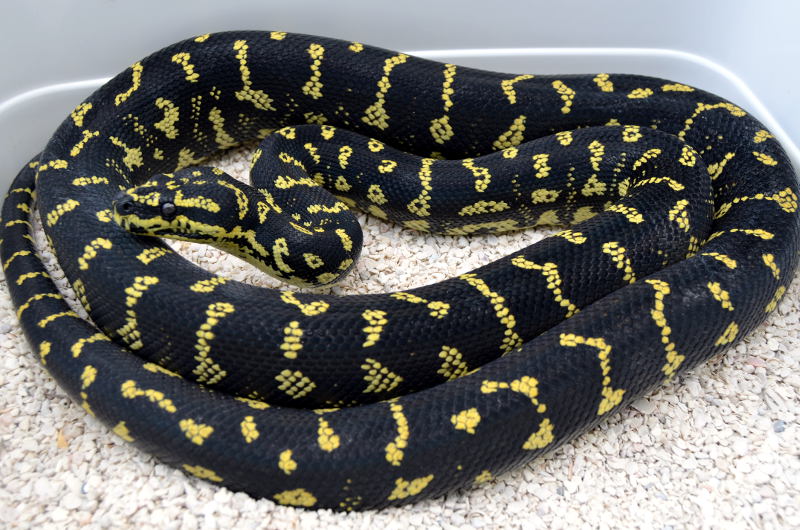
This subspecies lives in the most tropical habitat and is the smallest from all carpets they are don't longer than 6 - 7 ft. Jungle carpets lives in Queensland and Cape York Peninsula. These is the most arboreal species from all carpets and they inhabit a rain forest canopy.

Wild form
http://www.oakvalefarm.com.au/images/jungle_carpet_python.jpg

Ivory black and white form
http://www.theradzoo.com/wp-content/uploads/2012/09/Jungle-Carpet-Python.jpg

Tully locality jungle
http://i305.photobucket.com/albums/nn214/Red-Ink-Buldogs/Greyham/G15_zps77543b34.jpg

Babinda locality jungle
http://trexreptiles.net/wp-content/uploads/2012/08/babinda-4.jpg

Palmerston locality jungle
http://ih2.redbubble.net/image.4059535.5274/flat,550x550,075,f.jpg

Atherton localities jungle
http://www.ebmorelia.com/publishImages/Collection~~element219.jpg

Zebra jungle
Zebra is the co - dominant trait. The zebra gene is gene from jungle pythons.
http://www.ukpythons.com/imgs/gallery/zeb3.jpg

Super Zebra
http://www.ukpythons.com/imgs/gallery/szeb1.jpg

Striped/Tiger form
http://www.moreliapythonradio.com/publishImages/Morphs-of-the-Morelia-complex~~element87.jpg

Highlighter jungle
http://www.australianaddiction.com/JCP_Highlighter2013.jpg


Coastal carpet python (Morelia spilota mcdowelli)
-------------------------------------------------------------------------------------------------

Coastal carpet python is the biggest subspecies usually growth to 7 ft but 14 ft specimens are recorded. Coastals lives in wide range of habitats but mainly in forests. Range from Cape York peninsula to South Wales. This taxa is the most variable in patterns and colors which is presented in variety of morphs.

Wild form
http://www.ukpythons.com/imgs/gallery/BrF.jpg

Port Douglas localities coastal
http://www.ebmorelia.com/Port_Douglas-F.jpg

High contrast coastal
http://static.squarespace.com

High contrast tiger coastal
http://ectotherms.net/kyherpsoc/Propagating%20Carpet%20Pythons%20Webpage_files/image077.jpg

Red coastal
http://www.moreliapythonradio.com/publishImages/Morphs-of-the-Morelia-complex~~element239.jpg

Red tiger
http://www.moreliapythonradio.com/publishImages/Morphs-of-the-Morelia-complex~~element238.jpg

MPenn Line coastal
https://static.squarespace.com/static/502928b784ae02c19c94a1d1/502ad72a84ae8782450178d7/502ad730e4b0d642355d996c/1344984880495/Sonja%203.jpg?format=750w

Ocelot caramel
http://www.moreliapythonradio.com/publishImages/Morphs-of-the-Morelia-complex~~element247.jpg


MORE MORPHS Click Read More!

Wednesday, 29 October 2014

Pythons classification

Popular pythons form superfamilly Pythonidea and they are represent by 43 species (but expect more in future). Inside this superfamilly we have three families. First the most basal from them are Xenopeltidae (south-east Asian sunbeam snakes), Loxocemidae (Mexican Burrowin pythons) and of course Pythonidae. You are probably know that pythons are live in old world (Asia, Australia, Europe, Africa) and s-e Asian sunbeam snakes so what Mexican burrowing pythons doing in middle America. This is related with continental drift. Pythons evolved in Gondwanaland where all continents stick together. When continents start to divide some groups of animals are isolated on this swimming masses of land. Some of them menage to survive and this is the most probable scenario of distant living location of Mexican burrowing pythons. 
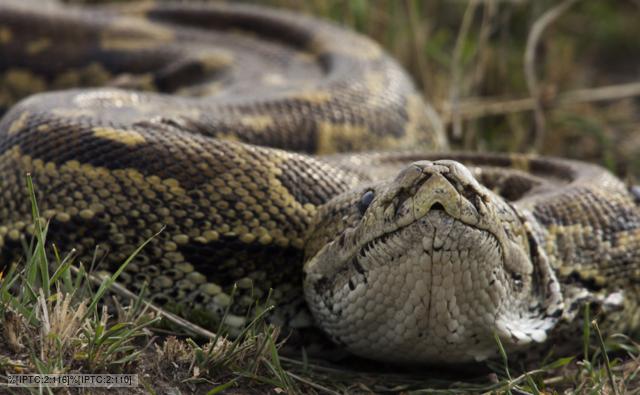
But back to topic. In newest research the most basal group (not primitive but they are more old in philogenetically terms than other pythons) are genus Python. Inside this genus we find for example African rock python and the most basal of all pythons Python regius probably the most widely breeded snake and better known under ball python name.

African rock python (P. sebae) from www.bbc.co.uk/nature/life/Python_sebae

We know that genus Python had heave inside a intruder, a reticulated python. Now reticulated python along with Timor python are form different taxa - Malayopython. In wide range of websites (wikipedia for example) they are still named as Python reticulatus or Python timorensis where they should be called Malayopython reticulatus and M. timorensis. However it is possible that in future genus Malayopython will have more species than those two.Why scientist wanted to divide this genus? Because reticulated python are more similar to Australian group of pythons instead of African and Asian mainland genus Python. Not that long ago reticulated python weren't in genus Python nor Malayopython but in Broghammerus. However the name Broghammerus was use against taxonomical law by R. Hoser. Mr Hoser have ability to be really problematic for taxonomists but abut that I say more another time. To help you move in this cclassificational dimension I share with you phylograme of pythons ( from Reynolds et al., 2014).

Reticulated python (M. reticulatus) from http://calphotos.berkeley.edu/

As you can see below on the top are most basal species and on bottom are the most advanced Australian species. Following those lines from left you can see that they are always divided on two. This way you can check what species are the closest relatives to another. 


Phylogeny of pythons and their distribution from Rawlings et al. 2014

In Australian pythons group we can see even more changes. Genus Morelia have been divided in two different groups. One group is carpet/tree pythons group and second one is group of amethystine/scrub pythons. All carpet and tree pythons are stay in genus Morelia but all amethystine pythons are move to genus Simalia. For example amethystine python are no longer Morelia amethystina but Simalia amethistina. In genus Simalia are a lot of new species thankfully for work of  (Schleip, 2008). In green tree python (Morelia viridis) populary named chondro (from their older name Chondropython). This is great that in future we could have two green tree python species Morelia viridis and Morelia azurea what I find very exciting. Also in carpet pythons it is possible that there are other species but there is needed more research. 

Moluccan python (S. clastolepis) from moreliapythonradio.com

As you can see on phylogramme above the sister genus to Morelia (closest relatives) are Antaresia who is popularly known as Children's pythons. Inside this genus I didn't notice any changes so lets move on. 
Next genus Liasis have some surprises for us. The olive python are no longer in their own genus Apodora but in Liasis. Liasis papuanus (olive python) could have cryptic species (not currently described). 

Olive python (L. olivaceus) from gondwanareptilesproductions.com

Genus Aspidites was prefiously taken by the most basal genus of all pythons (because they lack of thermal pits). However along with molecular data their status turn out to be one of the most advanced of all pythons. In genus Aspidites we can find small pythons dwelling on the ground and eating lizards and that's the reason why they lost thermal pits. Lizards are coldblooded (exothermic) so they have temperature as surroundings. In that way thermal pits were useless. They adapted to their prey and lost their thermoreceptic organ. Although pythons along with boas and vipers are known for having thermoreceptic organ the most important of all senses in snakes are chemoreceptive organ. That one which involved uses of divided tongue.
The last genus of pythons is Bothrochilus. This genus where old times was only Bothrochilus boa (Bismarck python) was merged with Leiopython. In this case Leiopython (D'alberts water pythons) are not longer exist and all old Leiopython species are now in Bothrochilus. In this genus we can also notice that there are no longer so few species. Instead of three species we can find there even seven species!

White - lipped python (B. alberisii) from http://www.natureswindow.dk/
where by the way he is still described as Leiopython.

I know that topic could be a little bit hard to follow and not all of you will enjoy reading it as I writing. Nevertheless I'm hoping that you will learn some new things and be at least surprised for those changes. And as you can see there is a lot of news in pythons. 
Look forward to new posts because next time I will write about classification of boas!


If you will have any questions feel free to ask me below.


Interesting literature:
  1.             Noonan, B.P., Chippindale, P.T., 2006a. Dispersal and vicariance: the complex evolutionary history of boid snakes. Molecular Phylogenetic Evolution 40, 347–58. doi:10.1016/j.ympev.2006.03.010
  2.              O’Shea, M., 2011. Boas & Pythons of the World. New Holland Publishers Ltd, London.
  3.              Pyron, R.A., Burbrink, F.T., Wiens, J.J., 2013. A phylogeny and revised classification of Squamata, including 4161 species of lizards and snakes. BMC Evolutionary Biology 13, 93. doi:10.1186/1471-2148-13-93
  4.              Rawlings, L.H., Barker, D., Donnellan, S.C., 2004. Phylogenetic relationships of the Australo-Papuan Liasis pythons (Reptilia : Macrostomata), based on mitochondrial DNA. Australian Journal of the Zoology. 52, 215–227.
  5.             Rawlings, L.H., Donnellan, S.C., 2003. Phylogeographic analysis of the green python, Morelia viridis, reveals cryptic diversity. Molecular Phylogenetic Evolution. 27, 36–44. doi:10.1016/S1055-7903(02)00396-2
  6.             Rawlings, L.H., Rabosky, D.L., Donnellan, S.C., Hutchinson, M.N., 2008. Python phylogenetics: inference from morphology and mitochondrial DNA. Biological Journal of the Linnean Society. 93, 603–619.
  7.             Reynolds, R.G., Niemiller, M.L., Revell, L.J., 2014. Toward a Tree-of-Life for the boas and pythons: Multilocus species-level phylogeny with unprecedented taxon sampling. Molecular Phylogenetic Evolution 71, 201–213. doi:10.1016/j.ympev.2013.11.011
  8.                Schleip, W., O’Shea, M., 2010. Annotated checklist of the recent and extinct pythons (Serpentes, Pythonidae), with notes on nomenclature, taxonomy, and distribution. ZooKeys 66. doi:10.3897/zookeys.66.683
  9.              Schleip, W.D., 2008. Revision of the Genus Leiopython Hubrecht 1879 (Serpentes: Pythonidae) with the Redescription of Taxa Recently Described by Hoser (2000) and the Description of New Species. Journal of Herpetology. 42, 645–667. doi:10.1670/06-182R5.1
  10.             Wiens, J.J., Hutter, C.R., Mulcahy, D.G., Noonan, B.P., Townsend, T.M., Sites, J.W., Reeder, T.W., 2012. Resolving the phylogeny of lizards and snakes (Squamata) with extensive sampling of genes and species. Biology Letters 8, 1043–1046. doi:10.1098/rsbl.2012.0703


Sunday, 26 October 2014

Current taxonomy of Boas and Pythons


Squamata (~ 9,556 species) was traditionally divided for lizards, worm lizards (Aphisbaenia) and snakes. New research founding however disagree with this taxonomy and establish that old divisions are paraphyletic (not all descendants are within right taxa). (To check snakes phylogeny follow names with green lines.) Currently we recognize five subordo Dibamidae, Gekkota, Scincimorfa, Lacertata and Toxicofera. Our beloved animals (snakes) are in Toxicofera subordo what you can see in graphic below. This group of animals are known for using venom (YES! Iguania and Anguimorpha distant relatives used venom in the past). Within Toxicofera we distinguish anguimorpha, iguanas and snakes. This taxa started to use venom approx 200 my ago in Triassic period. It's hard now to say what of this taxa are sister lineage to snakes (closest relatives). 


At present we recognize ~ 3,458 species of snakes which makes them one of the biggest taxa in all reptiles and even between other classes. And what is the most exciting thing there? - the species number in snakes still growths! Inside snakes we have simple division on two. First are basal Scoleocophidia (popular blind snakes) and the second one is Alethinophidia (true snakes). Because pythons and boas are Alethinophidians I will follow more deeply in this direction. As you can see below Alethinophidia are divide on another two taxa: Henophidia and Caenophidia (where Henophidia are more basal one). 

P. Puszkiewicz "Cranial morphology analysis in Pythonidae and Boidae in philogenetical and ecological context" 2014.

Now can be little bit harder.  We know now that pythons and boas are within Henophidia taxa but there is another artificial division for Macrostomata. Snakes in this taxa have ability to open they jaw widely or more simple snakes with large gapes. Inside Macrostomata we have also Caenophidia where we classified snakes such as cobras and vipers. Caenophidia are commonly known as advanced snakes and in this taxa we found most of the most venomous snakes. However they are don't interest us now we are curious about core Macrostomatan taxa - pythons and boas. They both contains 101 species which is quite nice number. As you can see pythons are don't longer within boas taxa. There are clear that this two groups are philogenetcially more distant than we thought (they are not close relatives). The similarities between boas and pythons are mostly results of similar ecology. We call this convergent evolution. These both groups are mirrors each other but there are some clear differences which about I write more in near future. We don't know everything about their origins but we can suspect that they are originated on earlier cretaceous Gondwanaland, and they divided from each other 40-30 my later.

To sum up this post  they are within Toxicofera taxa where are all reptiles with venom glands. Boas and pythons are also Alethinophidians and Henophidians. They also have possibility to largely open their gape (Macrostomata) in contrast to Uropeltidae for example. In the past pythons was classified as subfamilly of Boidae. Pythons are not boas! they form different taxa they are don't even sister taxa. Why I need to scream about that - because there are still places where they are grouped together.


Next time I will write more closely about pythons and boas because there are even more taxonomical changes!

Do you think that this changes are good or you prefer old classification?
Comment below and let me know what do you think.


Useful research papers

1.      Fry, B.G., Vidal, N., Norman, J.A., Vonk, F.J., Scheib, H., Ramjan, S.F.R., Kuruppu, S., Fung, K., Blair Hedges, S., Richardson, M.K., Hodgson, W.C., Ignjatovic, V., Summerhayes, R., Kochva, E., 2006. Early evolution of the venom system in lizards and snakes. Nature 439, 584–588. doi:10.1038/nature04328
2.      Fry, B.G., Vidal, N., van der Weerd, L., Kochva, E., Renjifo, C., 2009. Evolution and diversification of the Toxicofera reptile venom system. Journal of Proteomics 72, 127–136. doi:10.1016/j.jprot.2009.01.009
3.      Greene, H.W., Burghardt, G.M., 1978. Behavior and phylogeny: constriction in ancient and modern snakes. Science 200, 74–77. doi:10.1126/science.635575
4.      Kluge, A.G., 1991. Boine snake phylogeny and research cycles. Miscellaneous Publications of Michigan Museum of Zoology.
5.      Noonan, B.P., Chippindale, P.T., 2006. Dispersal and vicariance: the complex evolutionary history of boid snakes. Molecular Phylogenetic Evolution 40, 347–58. doi:10.1016/j.ympev.2006.03.010
6.      O’Shea, M., 2011. Boas & Pythons of the World. New Holland Publishers Ltd, London.
7.      Pyron, R.A., Burbrink, F.T., Wiens, J.J., 2013. A phylogeny and revised classification of Squamata, including 4161 species of lizards and snakes. BMC Evolutionary Biology 13, 93. doi:10.1186/1471-2148-13-93
8.      Reynolds, R.G., Niemiller, M.L., Revell, L.J., 2014. Toward a Tree-of-Life for the boas and pythons: Multilocus species-level phylogeny with unprecedented taxon sampling. Molecular Phylogenetic Evolution 71, 201–213. doi:10.1016/j.ympev.2013.11.011
9.      Schleip, W., O’Shea, M., 2010. Annotated checklist of the recent and extinct pythons (Serpentes, Pythonidae), with notes on nomenclature, taxonomy, and distribution. ZooKeys 66. doi:10.3897/zookeys.66.683
10.      Vidal, N., Delmas, A.-S., Hedges, S.B., 2007. The higher-level relationships of alethinophidian snakes inferred from seven nuclear and mitochondrial genes. Biology of Boas and Pythons 27–33.
11.      Vidal, N., Hedges, S.B., 2009. The molecular evolutionary tree of lizards, snakes, and amphisbaenians. Comptes Rendus Biologies. 332, 129–139. doi:10.1016/j.crvi.2008.07.010
12.      Wiens, J.J., Hutter, C.R., Mulcahy, D.G., Noonan, B.P., Townsend, T.M., Sites, J.W., Reeder, T.W., 2012. Resolving the phylogeny of lizards and snakes (Squamata) with extensive sampling of genes and species. Biology Letters 8, 1043–1046. doi:10.1098/rsbl.2012.0703