Showing posts with label Boas. Show all posts

Sunday, 19 July 2015

Arboreal adaptations of snakes.


To start with, I will show you pictures of snakes that occupy different ecosystems and you will probably instantly notice some differences between them. Those differences cover not only the appearance of the snakes but also their behaviour and foraging strategies.

Morelia viridis - Arboreal green tree python
http://www.reptilesmagazine.com/Care-Sheets/Snakes/Green-Tree-Python/


Cerastes Cerastes - Ground/burrowing  horned desert viper
http://rivista-cdn.reptilesmagazine.com/Hornviper_Cerastes_cerastes.jpg?ver=1385057346


Laticauda colubrina -  Sea living banded sea krait
http://www.arkive.org/banded-sea-krait/laticauda-colubrina/image-G125624.html

As you can see they are pretty different. What causes this variation? The answer is simple: Evolution! Those differences are adaptations to particular ecosystems. Snakes that occupy same or similar habitat will share some of the adaptations, for example, cryptic skin pattern of snakes' that hide between fallen leaves on the forest's ground.

But what about arboreal snakes? Does arboreal snakes share some similarities? 

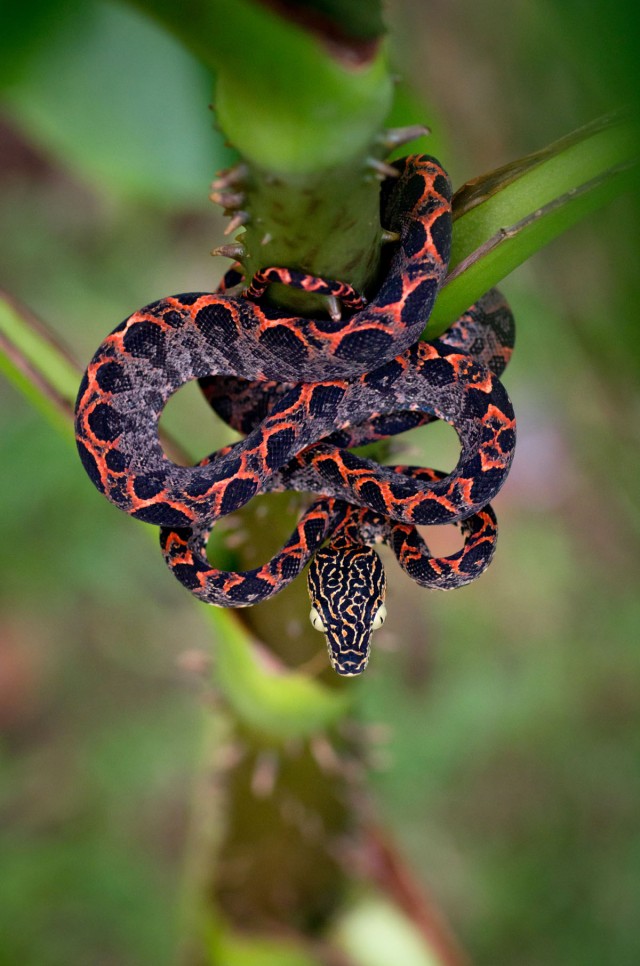
Amazon tree boa (Corallus hortulanus)
http://www.sciencephoto.com/media/379847/view

Asian vine snake (Ahaetulla prasina)
http://www.arkive.org/

Green pit viper (Trimeresurus albolabris)
http://commons.wikimedia.org/

These snakes represent three different taxa, so they aren't closely related to each other. Amazon tree boa represent Boidae and lives in South America, Asian vine snake is Colubrid snake from
South-East Asia as well as Green pit viper which, as name shows, represent Vipers. All of those snakes spent majority of their lives on trees and their branches.  There are a lot of shared adaptations which are common in arboreal snakes and rarely seen in snakes occupying different ecological niches. The arboreal specialization is  characteristic for tropical climate.


But what exactly 'Arboreal' means?
'Arboreal' (latin arbor - tree) means: Living in or among trees.
Putting this in more comprehensive answer, arboreality is a trait showing consistent association with trees. This trait is adaptive to some aspects of environmental and ecological conditions.

Arboreal snakes have several body modifications that help them survive and be successful predator in the tree canopy.


  • They have characteristic mid body lateral flatness, more broadly said, they are more slender and flatter than other non-arboreal snakes.
  • Longer tail length in relation to body length and tail prehensility (which means an organ adapted to holding or grasping)
  • Smaller sizes of clutches. The slender body might predestine those snakes to have smaller clutch size. This gives possibility for mothers not to have a handicap since they live on the trees. 
  • Shift in the position of ovaries. This ovarian asymmetry gives them ability to minimize body distention during pregnancy period. Lack of strong distention keeps them slender even while keeping big follicles.
  • Ontogenetic color changes and polimorphism. It enables snakes' to live in different ecological niches (for example in different height of the trees).
  • High aggression (decreases with age). It is defending mechanism for youths and an excellent feeding response that helps them survive in natural environment and to thrive in captivity.
  • Bigger heads in relativity to body length and generally, strong, heart-shaped heads. This distinctive shape is a result of presence of strong jaw muscles to prevent their prey from escape. 
  • Longer teeth. Arboreal snakes have one of the longest teeth in snake's world. For example Emerald tree python and Green tree python can reach teeth size of 3-4 cm that is close to length of Gabon viper fangs (longest snake-world fangs)!

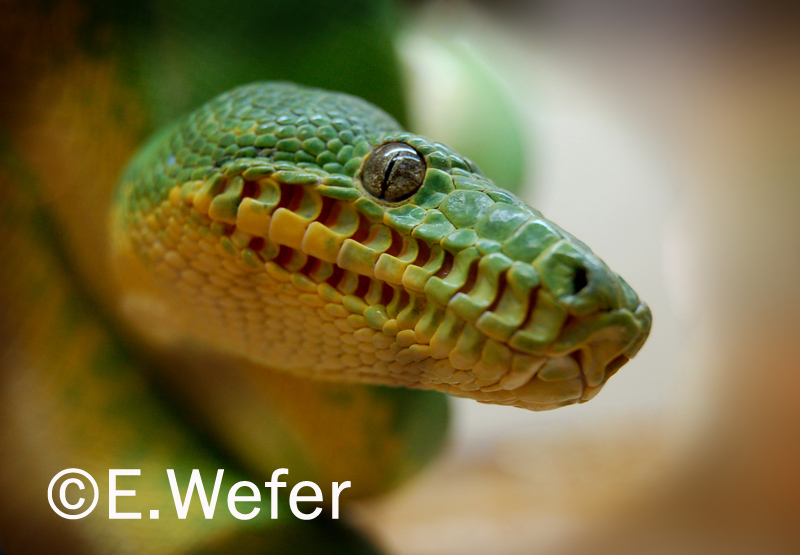
This is a head of Emerald tree boa that I have dissected a year ago. You can see there a pretty devastating teeth (and yes! during preparation my gloves were pierced all the time).
  • My research suggests that constricting snakes like pythons and boas have lengthen nasal complex in relativity to other snakes, that probably allows them more precise grasp of the agile prey. You can see this long nasal complex on the picture above. 
  • Good vision. We can even assume that the best from all snakes: from excellent binocular vision of vine snakes to special light reflecting layer of tapetum lucidum in tree boas (that's why one of the easiest ways of searching for those snakes is with flashlight). Good vision helps them localize prey and be more accurate during striking.

https://blogger.googleusercontent.com/img/b/R29vZ2xl/AVvXsEhNcAcV-lGQltiURD6sRGW8rrTgwAKwBmMvHbXgF-A57jeKwF5PsMvxPrIjRvFqpH56duy1Z5CWhFoLS-GanZs4QMzukCs-XI9_2lPSK4V0SEaH3YtYnvCkwHeA5a_PidmLrdb_SalURkca/s1600/Tree+boa.JPG

  •  Arboreal snakes have almost no possibility for precise thermoregulation. There is a small amount of sunlight that pierce trough dense tree canopy and all sunny locations are unpopular, probably because of the risk of predation. As a result of living in this environment they have lower body temperature than other snakes. Additionally, the arboreal nocturnal snakes have lower body temperature than diurnal arboreal snakes (which is quite obvious).


The ultimate adaptation to living on tress is diving, or air sliding, or more popularly called - flying.
The South-East Asian Chrysoplea taxa, known as paradise snakes, posseses the ability to move from one tree to another trough gliding in the air. This is really amazing and in few words it is achieved by basically further flattening the body. 
Here is a short video from National Geographic where you can see this amazing ability.


Arboreal snakes are highly adapted to their environment and they are undoubtedly successful predators. Those interesting snakes in a variety of ways are 'marvelous monsters' of the natural world and as a pet snake they can give an opportunity to observe interesting behaviours and admire unique colors and patterns. The only disadvantages with those snakes are high price and demand of specific conditions to keep (and breed) them with success.

I think this post is already longer that I've expected, so if you'll still have any questions, do not hesitate to ask in comments section  and I will try my best to answer them.
Cheerio!

Thursday, 30 October 2014

Boas classification

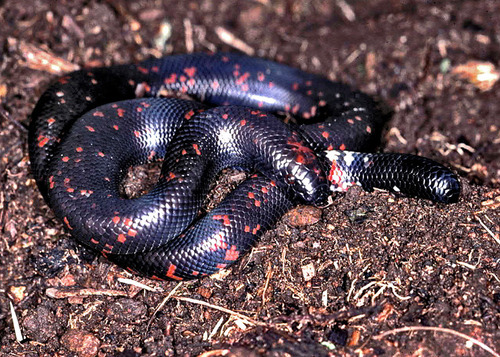
Boidea (58 species) is a superfamilly of popular boas. Inside this taxa we don't find anymore calabar ground python. Long time ago he was classified as python but actually he isn't python nor boa and form another his own superfamilly Calabariidea (with one species). However Calabaria reinhardi (calabar ground boa or calabaria) is still in Erycinae family (old world sand boas) which ones he is isn't close relatives. I need to mention that this still will change because Sanziniinae are paraphiletictaxa (not all relatives are in this group), One of the biggest differences between calabria and boas are in the methods of reproduction. Boas are viviparous and calabarias are oviparous. 
In endemic Madagascar boas (Sanziniinae) are no longer single species but two. The subspecies S. madagascarensis volontany has been raised to species status. In genus Arcantophis are still some unsure systematic positions but this needed further studies.

Calabaria from http://www.inaturalist.org if you look closely you will see that his tail resemblance head!

Subfamilly Erycinae are not longer contain Lichanura, Charina,  Exilboa and Ungaliophis (ground boas). Yhey are expelled from Erycinae and form their own subfamilly Ungaliophidae. There are also clear that Lichanura and Charina are genus reserved for New world while Exilboa and Ungaliophis for Old world. So if you ever read about species from Charina genus you will automatically known that this snake is from New world. In genus Eryx we can suspect in future few new species. 
Very interesting genus Candoia form his own subfamilly Candoinae and they are closely related to Boinae. The very interesting thing about this genus is that the live on far away land from Boinae homeland. They are distributed on Melanseia, Micronesia, Papua New Guinea islands where all Boinae are reserved to New world.


Boas phylogeny from Rawlings et al 2014.

There is interesting information for boa constrictor keepers! They are in familly Boinae and subspecies of boa constrictor B. c. imperator are now species Boa imperator. In future in this genus we can also expect some changes.
In genus Corallus nothing change now although we can assume that in future Corallus hortulanus can be divided on different species.

Amazon tree boa from http://www.coralluscaninus.info aren't they sweeties?

All anacondas (Eunectes genus) are the closest relatives of rainbow boas (Epicrates). Well they are don't so similar to each other when you look at them. However the molecular and genetic research proof that they are close relatives (they are sharing common ancestor). Some species are no longer in Epicrates but they are form different genus Chilabothrus (west Indian boas).  If you have for example Hispaniolan boa (C. striatus) he is not longer Epicrates but Chilabothrus. All species from Epicrates are reserved to South American mainland and Chilabothrus to West Indian Islands.


Yep that's all I'v hope that you are enjoyed my article and you are glad to hear that B. imperatus are species not subspecies. 

If you want fell free to post a comment below, I would greatly appreciate any feedback.
What is your favorite boa share below your favorite species and/or morph of this amazing creatures.

Is hard to decide which one i love the most so I post there two! :P
   Emerald tree boa  (from calphotos.berkeley.edu)                                                  Amazon tree boa                                                                                                                                      Halloween morph                                                                                                             (from http://www.une-saison-en-guyane.com)


Interesting literature:
  1. Austin, C.C., 2000. Molecular Phylogeny and Historical Biogeography of Pacific Island Boas (Candoia). Copeia 2000, 341–352. doi:10.1643/0045-8511(2000)000[0341:MPAHBO]2.0.CO;2
  2. Boback, S.M., 2005. Natural History and Conservation of Island Boas (Boa Constrictor) in Belize. Copeia 2005, 879–884. doi:10.1643/0045-8511(2005)005[0879:NHACOI]2.0.CO;2
  3. Chiaraviglio, M., Bertona, M., Sironi, M., Lucino, S., 2003. Intrapopulation variation in life history traits of Boa constrictor occidentalis in Argentina. Amphibia and Reptilia. 24, 65–74.
  4. Colston, T.J., Grazziotin, F.G., Shepard, D.B., Vitt, L.J., Colli, G.R., Henderson, R.W., Blair Hedges, S., Bonatto, S., Zaher, H., Noonan, B.P., Burbrink, F.T., 2013. Molecular systematics and historical biogeography of tree boas (Corallus spp.). Molecular Phylogenetic Evolution 66, 953–959. doi:10.1016/j.ympev.2012.11.027
  5. Henderson, R.W., 1997. A taxonomic review of the Corallus hortulanus complex of Neotropical tree boas. Caribbean Journal of Science. 33, 198–221.
  6. Henderson, R.W., Pauers, M.J., Colston, T.J., 2013. On the congruence of morphology, trophic ecology, and phylogeny in Neotropical treeboas (Squamata: Boidae: Corallus). Biological Journal of the Linnean Society 109, 466–475.
  7. Hynková, I., Starostová, Z., Frynta, D., 2009. Mitochondrial DNA Variation Reveals Recent Evolutionary History of Main Boa constrictor Clades. Zoological Science 26, 623–631. doi:10.2108/zsj.26.623
  8. Martins, M., Oliviera, M.E., 1999. Natural History of snakes in Forests in the Manaus Region Central Amazonia, Brazil. Natural History Notes 6, 78–150.
  9. Monteiro, L.R., 1998. Ontogcnetic changes in the skull of Corallus caninus L., 1758 and Corallus enydris L., 1758 (Serpentes: Boidae), an allometric study. SNAKE-NITTAGUN- 28, 51–58.
  10. Noonan, B.P., Chippindale, P.T., 2006a. Dispersal and vicariance: the complex evolutionary history of boid snakes. Molecular Phylogenetic Evolution 40, 347–58. doi:10.1016/j.ympev.2006.03.010
  11. Noonan, B.P., Chippindale, P.T., 2006b. Vicariant Origin of Malagasy Reptiles Supports Late Cretaceous Antarctic Land Bridge. American Naturalist 168, 730–741. doi:10.1086/509052
  12. Noonan, B.P., Sites Jr., J.W., 2010. Tracing the Origins of Iguanid Lizards and Boine Snakes of the Pacific. American Naturalist 175, 61–72. doi:10.1086/648607
  13. Orozco-Terwengel, P., Nagy, Z.T., Vieites, D.R., Vences, M., Louis Jr, E., 2008. Phylogeography and phylogenetic relationships of Malagasy tree and ground boas. Biological Journal of the Linnean Society. 95, 640–652. doi:10.1111/j.1095-8312.2008.01083.x
  14. Pizzatto, L., Marques, O.A., Facure, K., 2009. Food habits of Brazilian boid snakes: overview and new data, with special reference to Corallus hortulanus. Amphibia - Reptilia. 30, 533–544.
  15. Pyron, R.A., Burbrink, F.T., Wiens, J.J., 2013. A phylogeny and revised classification of Squamata, including 4161 species of lizards and snakes. BMC Evolutionary Biology 13, 93. doi:10.1186/1471-2148-13-93
  16. Reynolds, R.G., Niemiller, M.L., Hedges, S.B., Dornburg, A., Puente-Rolón, A.R., Revell, L.J., 2013. Molecular phylogeny and historical biogeography of West Indian boid snakes (Chilabothrus). Molecular Phylogenetic Evolution 68, 461–470. doi:10.1016/j.ympev.2013.04.029 48
  17. Reynolds, R.G., Niemiller, M.L., Revell, L.J., 2014. Toward a Tree-of-Life for the boas and pythons: Multilocus species-level phylogeny with unprecedented taxon sampling. Molecular Phylogenetic Evolution 71, 201–213. doi:10.1016/j.ympev.2013.11.011


Sunday, 26 October 2014

Current taxonomy of Boas and Pythons


Squamata (~ 9,556 species) was traditionally divided for lizards, worm lizards (Aphisbaenia) and snakes. New research founding however disagree with this taxonomy and establish that old divisions are paraphyletic (not all descendants are within right taxa). (To check snakes phylogeny follow names with green lines.) Currently we recognize five subordo Dibamidae, Gekkota, Scincimorfa, Lacertata and Toxicofera. Our beloved animals (snakes) are in Toxicofera subordo what you can see in graphic below. This group of animals are known for using venom (YES! Iguania and Anguimorpha distant relatives used venom in the past). Within Toxicofera we distinguish anguimorpha, iguanas and snakes. This taxa started to use venom approx 200 my ago in Triassic period. It's hard now to say what of this taxa are sister lineage to snakes (closest relatives). 


At present we recognize ~ 3,458 species of snakes which makes them one of the biggest taxa in all reptiles and even between other classes. And what is the most exciting thing there? - the species number in snakes still growths! Inside snakes we have simple division on two. First are basal Scoleocophidia (popular blind snakes) and the second one is Alethinophidia (true snakes). Because pythons and boas are Alethinophidians I will follow more deeply in this direction. As you can see below Alethinophidia are divide on another two taxa: Henophidia and Caenophidia (where Henophidia are more basal one). 

P. Puszkiewicz "Cranial morphology analysis in Pythonidae and Boidae in philogenetical and ecological context" 2014.

Now can be little bit harder.  We know now that pythons and boas are within Henophidia taxa but there is another artificial division for Macrostomata. Snakes in this taxa have ability to open they jaw widely or more simple snakes with large gapes. Inside Macrostomata we have also Caenophidia where we classified snakes such as cobras and vipers. Caenophidia are commonly known as advanced snakes and in this taxa we found most of the most venomous snakes. However they are don't interest us now we are curious about core Macrostomatan taxa - pythons and boas. They both contains 101 species which is quite nice number. As you can see pythons are don't longer within boas taxa. There are clear that this two groups are philogenetcially more distant than we thought (they are not close relatives). The similarities between boas and pythons are mostly results of similar ecology. We call this convergent evolution. These both groups are mirrors each other but there are some clear differences which about I write more in near future. We don't know everything about their origins but we can suspect that they are originated on earlier cretaceous Gondwanaland, and they divided from each other 40-30 my later.

To sum up this post  they are within Toxicofera taxa where are all reptiles with venom glands. Boas and pythons are also Alethinophidians and Henophidians. They also have possibility to largely open their gape (Macrostomata) in contrast to Uropeltidae for example. In the past pythons was classified as subfamilly of Boidae. Pythons are not boas! they form different taxa they are don't even sister taxa. Why I need to scream about that - because there are still places where they are grouped together.


Next time I will write more closely about pythons and boas because there are even more taxonomical changes!

Do you think that this changes are good or you prefer old classification?
Comment below and let me know what do you think.


Useful research papers

1.      Fry, B.G., Vidal, N., Norman, J.A., Vonk, F.J., Scheib, H., Ramjan, S.F.R., Kuruppu, S., Fung, K., Blair Hedges, S., Richardson, M.K., Hodgson, W.C., Ignjatovic, V., Summerhayes, R., Kochva, E., 2006. Early evolution of the venom system in lizards and snakes. Nature 439, 584–588. doi:10.1038/nature04328
2.      Fry, B.G., Vidal, N., van der Weerd, L., Kochva, E., Renjifo, C., 2009. Evolution and diversification of the Toxicofera reptile venom system. Journal of Proteomics 72, 127–136. doi:10.1016/j.jprot.2009.01.009
3.      Greene, H.W., Burghardt, G.M., 1978. Behavior and phylogeny: constriction in ancient and modern snakes. Science 200, 74–77. doi:10.1126/science.635575
4.      Kluge, A.G., 1991. Boine snake phylogeny and research cycles. Miscellaneous Publications of Michigan Museum of Zoology.
5.      Noonan, B.P., Chippindale, P.T., 2006. Dispersal and vicariance: the complex evolutionary history of boid snakes. Molecular Phylogenetic Evolution 40, 347–58. doi:10.1016/j.ympev.2006.03.010
6.      O’Shea, M., 2011. Boas & Pythons of the World. New Holland Publishers Ltd, London.
7.      Pyron, R.A., Burbrink, F.T., Wiens, J.J., 2013. A phylogeny and revised classification of Squamata, including 4161 species of lizards and snakes. BMC Evolutionary Biology 13, 93. doi:10.1186/1471-2148-13-93
8.      Reynolds, R.G., Niemiller, M.L., Revell, L.J., 2014. Toward a Tree-of-Life for the boas and pythons: Multilocus species-level phylogeny with unprecedented taxon sampling. Molecular Phylogenetic Evolution 71, 201–213. doi:10.1016/j.ympev.2013.11.011
9.      Schleip, W., O’Shea, M., 2010. Annotated checklist of the recent and extinct pythons (Serpentes, Pythonidae), with notes on nomenclature, taxonomy, and distribution. ZooKeys 66. doi:10.3897/zookeys.66.683
10.      Vidal, N., Delmas, A.-S., Hedges, S.B., 2007. The higher-level relationships of alethinophidian snakes inferred from seven nuclear and mitochondrial genes. Biology of Boas and Pythons 27–33.
11.      Vidal, N., Hedges, S.B., 2009. The molecular evolutionary tree of lizards, snakes, and amphisbaenians. Comptes Rendus Biologies. 332, 129–139. doi:10.1016/j.crvi.2008.07.010
12.      Wiens, J.J., Hutter, C.R., Mulcahy, D.G., Noonan, B.P., Townsend, T.M., Sites, J.W., Reeder, T.W., 2012. Resolving the phylogeny of lizards and snakes (Squamata) with extensive sampling of genes and species. Biology Letters 8, 1043–1046. doi:10.1098/rsbl.2012.0703